Adé House
A boutique concept hotel brand in Lekki Phase 1, Lagos — designed, branded, and built end-to-end as a six-suite private residence.
- Client
- Concept Project — Adé House
- Timeline
- 1 week
- Stack
- Lovable · Claude · HTML/CSS · Vercel
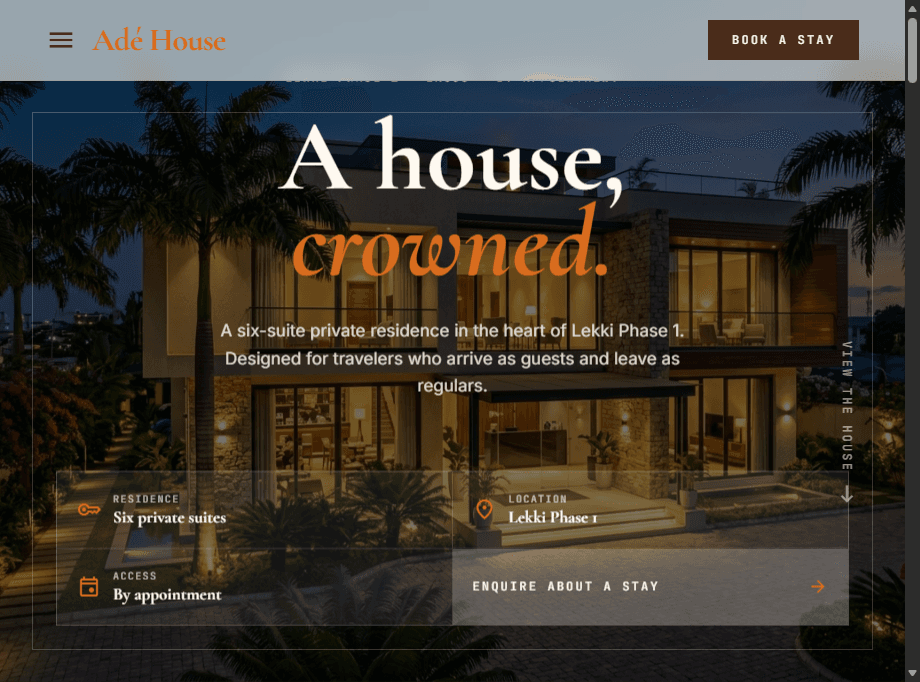
A boutique concept brand, designed and built in a single sprint.
The Brief
Adé House is a concept brand for a fictional boutique hotel in Lekki Phase 1, Lagos. The exercise: position hospitality as the opposite of a hotel — a private home opened to a quiet few — and design, brand, and build the entire web presence end-to-end in a single sprint.
"Adé" is Yoruba for crown. The tagline, "A house, crowned." The positioning, in one line: not a hotel, a house. Everything downstream (palette, type, copy, photography, navigation, the form) had to honour that single idea or it didn't ship.
My Role
Solo designer and developer. I owned positioning, brand voice, copy, visual direction, code, and deployment. Built with HTML, Tailwind via CDN, and progressively layered vanilla JavaScript — a deliberately lean stack to test how fast a polished hospitality brand could ship without React or a CMS.
Key Decisions
Editorial voice over marketing copy. Most hospitality sites read like brochures. I wrote Adé House the way a confident host would speak — short sentences, specific details, no hero buttons demanding "Book your stay now." Every page tries to feel like a real residence run by real people, not a templated funnel.
Yoruba as a design system, not decoration. The six suites are named for Yoruba words — Òrun (Sky), Ìlú (City), Omi (Water), Igbó (Forest), Adé (Crown), Ìmọ̀ (Light) — and each suite is built around the feeling its word holds. Yoruba diacritics are typeset properly throughout, not flattened. The cultural reference is treated as a system, not garnish.
Quiet luxury palette and editorial type. A high-contrast serif (Cormorant Garamond) paired with a clean grotesque sans (Inter) carries the premium feel without decorative flourishes. The colour blocking — warm terracotta, deep mahogany, eggshell, marigold — was deliberately closer to a Lagos residence than a five-star chain.
Enquiry-led, not transaction-led. No public pricing. No instant-book. No dropdown date picker. The whole booking surface is an enquiry form with a twelve-hour reply promise. That single decision keeps the brand consistent: a boutique residence you ask about, not a hotel you check into.
AI-generated photography for the concept. The site was originally built with placeholder hospitality stock. This week I swapped every image for AI-generated photography produced specifically for the brand — exterior at dusk, the six named suites, the kitchen, the spa, the location. The whole site reads as one cohesive visual identity rather than a sampler of stock.
What Shipped
Seven fully responsive pages — home, the six suites, kitchen, gallery, story, enquiry, contact — deployed on Vercel. Vanilla HTML, Tailwind CSS via CDN, vanilla JavaScript.
The site includes smooth scroll, scroll-triggered reveals, a working image gallery with lightbox, an immersive-reveal suite list (hover a row to crossfade the background to that suite's photo), a slide-in mobile navigation, and a client-side enquiry form ready to wire to a real backend.
Outcomes
As a concept project, the outcome is the case study itself — a complete, brand-aligned hospitality site shipped end-to-end in a single sprint, evidence of speed without sacrificing craft.
The project also became a working template I can adapt for real hospitality clients in a fraction of the time it would take to build from scratch.
What I'd Do Differently
For a real engagement, the AI-generated photography would become a small photo sprint — even three or four custom shots of an actual property dramatically outperform anything generated.
I'd also build in a real booking integration — Cloudbeds, Mews, or a custom Stripe flow — instead of stopping at an enquiry form. Concept sites are forgiven for stopping there; a working hospitality brand needs the full transaction loop.